Henry Smith Williams

We have seen how Gilbert, by his experiments with magnets, gave an impetus to the study of magnetism and electricity. Gilbert himself demonstrated some facts and advanced some theories, but the system of general laws was to come later. To this end the discovery of electrical repulsion, as well as attraction, by Von Guericke, with his sulphur ball, was a step forward; but something like a century passed after Gilbert's beginning before anything of much importance was done in the field of electricity.

Modern systematic botany and zoology are usually held to have their beginnings with Linnaeus.

An obvious distinction between the classical and mediaeval epochs may be found in the fact that the former produced, whereas the latter failed to produce, a few great thinkers in each generation who were imbued with that scepticism which is the foundation of the investigating spirit; who thought for themselves and supplied more or less rational explanations of observed phenomena. Could we eliminate the work of some score or so of classical observers and thinkers, the classical epoch would seem as much a dark age as does the epoch that succeeded it.

The successors of Mohammed showed themselves curiously receptive of the ideas of the western people whom they conquered. They came in contact with the Greeks in western Asia and in Egypt, and, as has been said, became their virtual successors in carrying forward the torch of learning. It must not be inferred, however, that the Arabian scholars, as a class, were comparable to their predecessors in creative genius. On the contrary, they retained much of the conservative oriental spirit.

We have previously referred to the influence of the Byzantine civilization in transmitting the learning of antiquity across the abysm of the dark age. It must be admitted, however, that the importance of that civilization did not extend much beyond the task of the common carrier. There were no great creative scientists in the later Roman empire of the East any more than in the corresponding empire of the West. There was, however, one field in which the Byzantine made respectable progress and regarding which their efforts require a few words of special comment.

We have seen that the Ptolemaic astronomy, which was the accepted doctrine throughout the Middle Ages, taught that the earth is round. Doubtless there was a popular opinion current which regarded the earth as flat, but it must be understood that this opinion had no champions among men of science during the Middle Ages. When, in the year 1492, Columbus sailed out to the west on his memorable voyage, his expectation of reaching India had full scientific warrant, however much it may have been scouted by certain ecclesiastics and by the average man of the period.

After Galileo had felt the strong hand of the Inquisition, in 1632, he was careful to confine his researches, or at least his publications, to topics that seemed free from theological implications. In doing so he reverted to the field of his earliest studies —namely, the field of mechanics; and the Dialoghi delle Nuove Scienze, which he finished in 1636, and which was printed two years later, attained a celebrity no less than that of the heretical dialogue that had preceded it.

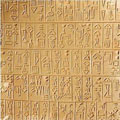
Before we turn specifically to the new world of the west, it remains to take note of what may perhaps be regarded as the very greatest achievement of ancient science. This was the analysis of speech sounds, and the resulting development of a system of alphabetical writing. To comprehend the series of scientific inductions which led to this result, we must go back in imagination and trace briefly the development of the methods of recording thought by means of graphic symbols. In other words, we must trace the evolution of the art of writing.

Herodotus, the Father of History, tells us that once upon a time—which time, as the modern computator shows us, was about the year 590 B.C. —a war had risen between the Lydians and the Medes and continued five years. "In these years the Medes often discomfited the Lydians and the Lydians often discomfited the Medes (and among other things they fought a battle by night); and yet they still carried on the war with equally balanced fortitude. In the sixth year a battle took place in which it happened, when the fight had begun, that suddenly the day became night.

Syndicate content