Science

What Happens When You Talk into a Telephone Receiver

A Typesetting Machine That Makes Mathematical Calculations

ARTIFICIAL ICE-MAKING

One midsummers day a fleet of United States war-ships were lying at anchor in Guantanamo Bay, on the southern coast of Cuba. The sky was cloudless, and the tropic sun shone so fiercely on the decks that the bare-footed Jackies had to cross the unshaded spots on the jump to save their feet.

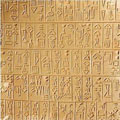
HOW THE "RIDDLE OF THE SPHINX" WAS READ

The development of the science of chemistry from the "science" of alchemy is a striking example of the complete revolution in the attitude of observers in the field of science. As has been pointed out in a preceding chapter, the alchemist, having a preconceived idea of how things should be, made all his experiments to prove his preconceived theory; while the chemist reverses this attitude of mind and bases his conceptions on the results of his laboratory experiments. In short, chemistry is what alchemy never could be, an inductive science.

ALBRECHT VON HALLER

An epoch in physiology was made in the eighteenth century by the genius and efforts of Albrecht von Haller (1708-1777), of Berne, who is perhaps as worthy of the title "The Great" as any philosopher who has been so christened by his contemporaries since the time of Hippocrates. Celebrated as a physician, he was proficient in various fields, being equally famed in his own time as poet, botanist, and statesman, and dividing his attention between art and science.

Syndicate content